Activating behavior change for proper waste disposal in WA

Environmental Studies majors take part in a unique 3-quarter Capstone experience combining professional development, a built-in internship (locally or abroad) and a public presentation tying in their academic research with their practical on-the-job work. Students gain valuable hands-on experience exploring potential career paths and they build communications, research and analytic skills that serve them well beyond their time at college. 

Read more about what the student experience is within our Capstone, in this third post in our Student Capstone Q&A Series.

Brooke Stroosma

Capstone Internship focus: Accurate Waste Disposal
Capstone organization: Waste Management
UW faculty mentor: Yen-Chu Weng

Why did you choose this internship?

I chose to do my capstone internship with Waste Management’s Recycle Corps internship program because this was an opportunity to step out of my comfort zone. Before this internship I did not know much about the waste industry besides me putting my recycling and garbage at the curb and someone picking it up every week. I also chose this internship because I wanted to get experience working for a private company in my field and learn how to educate the public on a broad scale.

What environmental challenges are you addressing? Why is it important?

One challenge that I addressed through my internship was lack of access and knowledge to recycling and composting. It is important to provide correct access and knowledge to communities about recycling and composting so that we are able to decrease the amount of materials that end up in landfills and then strive to decrease our consumption entirely.

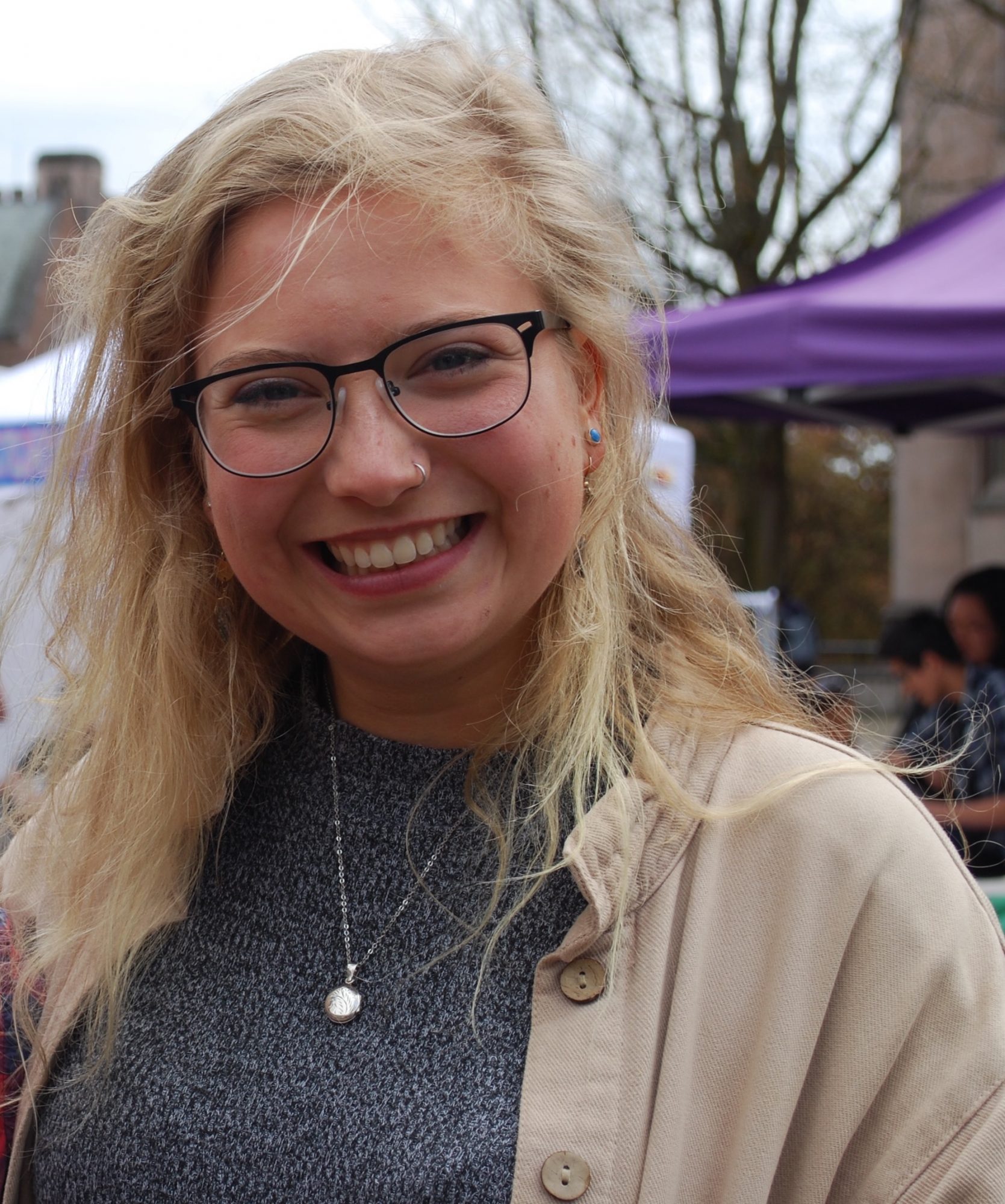
Brooke Stroosma fielding questions about recycling at a Waste Management info fair.
Brooke Stroosma fielding questions about recycling at a Waste Management outreach event.

What are the goals of this internship and what are your expected deliverables?

A goal that I had going into my internship was to make connections and contacts with everyone I met during the summer. I was able to do this and find direction in what I want to do after I graduate. My deliverable for my host organization was to draft an outreach report for one of the communities I worked with this summer.

What does a day in the life of your internship look like?

Every day is different at my internship. There are always new projects that are happening. I worked events and did outreach at multifamily properties and businesses. My favorite day during my internship was getting to do door-to-door outreach at multifamily properties and individually have conversations with the residents about how they can decrease their waste and improve their recycling and composting behaviors.

What skills have you learned throughout this internship?

A few skills that I learned through my internship include; professional outreach and education tools, data analysis, and writing a comprehensive report.

What is the most memorable moment of this internship so far?

The most memorable part of my internship has been able to see a spark in someone’s eye when they want to do what is best for our environment and they want to take the knowledge and information that I provided for them and use it to be more environmentally friendly.

What are your career aspirations once you graduate?

After I graduate I want to continue with education and outreach on environmental topics. It might be in the waste industry or it might not! I am very open for what comes next!
Ferns are dying in Kitsap forests, and nobody knows why

For the past three years, Program on the Environment lecturer Tim Billo has been monitoring the sword fern die-off in Seattle’s Seward Park. He’s not the only researcher to be stumped by the mysterious decline of this once abundant plant that covers the forest floors.

Despite copious research, nobody has yet found the reason for the rapid and alarming decline of this ubiquitous Northwest plant, which is now disappearing in the North Kitsap forests as well. This plant is not easy to kill, and its plight is attracting the interest of more researchers and naturalists.

Read more at the Kitsap Sun. 


The “global flip”: a new model for international learning

A new course add-on option adds short-term travel to international, online collaboration — helping more students to have rich global learning experiences, at home and abroad.

Teaching sustainability through international partnership

Kristi Straus, lecturer, Program on the Enivronment

Kristi Straus, lecturer in the College of the Environment, knew that her students could learn an enormous amount about sustainability issues if they could place them in more global context. But traditional study abroad programs aren’t always feasible, or accessible, for many students.

So when Straus was approached by the Academic & Student Affairs in Fall 2017 to design and pilot a new “global flip” course model, she jumped at the chance to add a short-term study abroad option to her introductory course on sustainability.

Straus partnered with professors at Tsinghua University in Beijing to design an international — and internationally collaborative — component to her ENVIR 239 Sustainability: Personal Choices, Broad Impacts course. The 15 students who enrolled in the “global flip” option (of 80 total students in the course) worked alongside their peers in China to tackle real environmental issues in both countries — first online, then in-person — without the time or cost of traditional study abroad.

READ MORE AT UW TRENDS AND ISSUES IN HIGHER ED


Beth Wheat speaks about her dual role on “In Our Nature” podcast

No matter what’s she’s done and where’s she’s gone, she’s drawn to planting seeds and growing food.

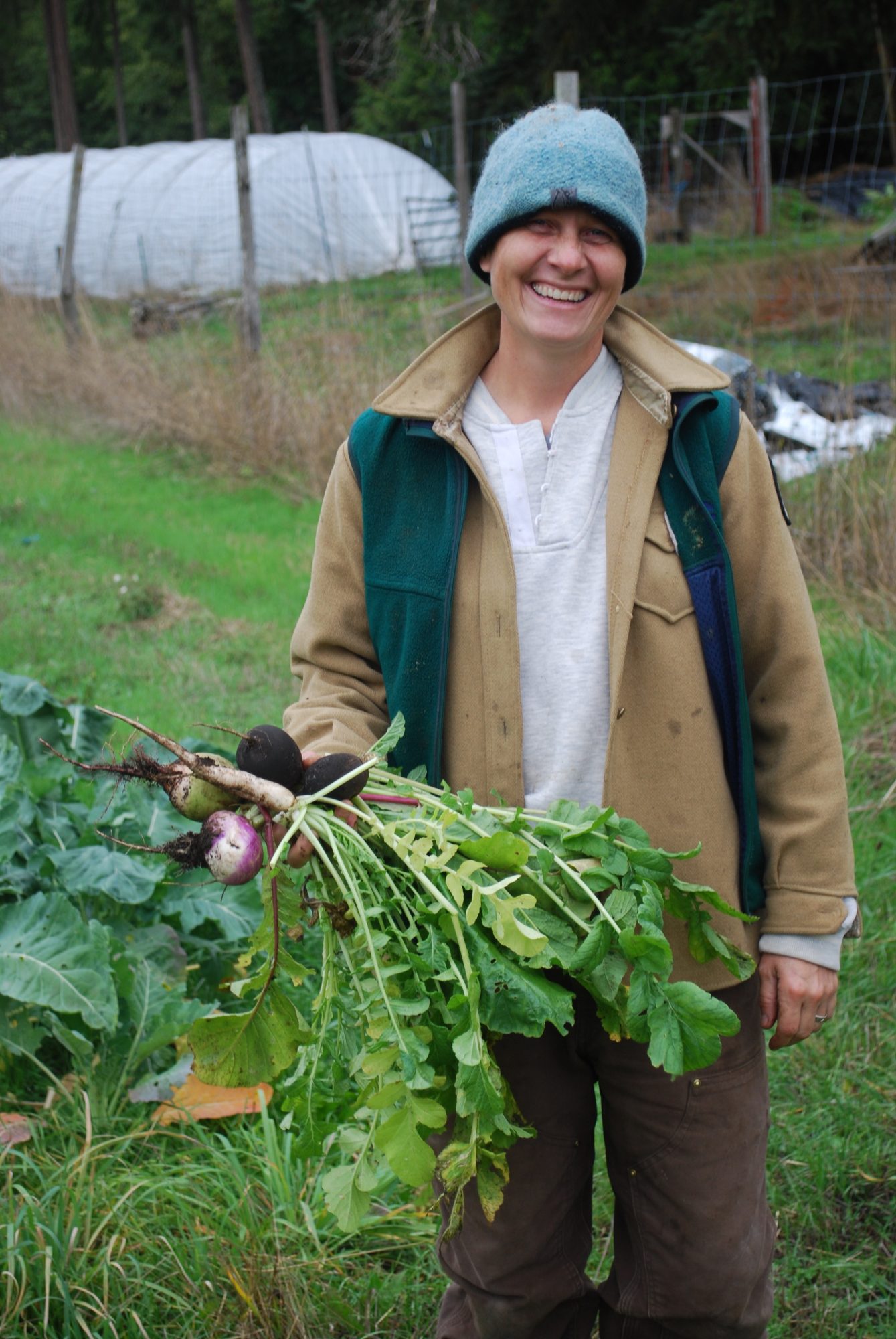
Beth at SkyRoots, her farm on Whidbey Island.

Achieving financial sustainability through regenerative agriculture is tough, but it’s a worthwhile endeavor for Elizabeth Wheat, who runs SkyRoot Farm and teaches at UW’s Program on the Environment.

A recent recipient of the College of the Environment’s outstanding teaching award (she also received the UW’s excellence in teaching award back in 2010) and a Husky Green award earlier this year, Elizabeth Wheat is known and adored for her enthusiastic teaching style and love for food, farming and community.

Students gush about her, and many at UW enjoy her farm’s CSA produce.

Listen to UW Sustainability’s podcast to get a taste of the infamous Beth Wheat’s energy, to understand more about regenerative agriculture, and to hear what it’s like to be both a farmer and an educator.

On balancing her dual roles:

“Balance is not my aim, it’s a structural revolution in our food system, and this sense of urgency is what drives me forward and fuels me.”

Regenerative agriculture restores ecosystem function on an agricultural landscape. One of the primary tools is the management of organic matter on the soil.

Sky Root is focused on the life of the soil. On 20 acres of land on South Whidbey Island, Beth integrates animals into their production. Chicken, goats, ducks and worms all facilitate the growth of the vegetables on the farm.

IN OUR NATURE PODCAST EPISODE 5: BETH WHEAT


Student research reveals barriers to bike riding in one Seattle neighborhood

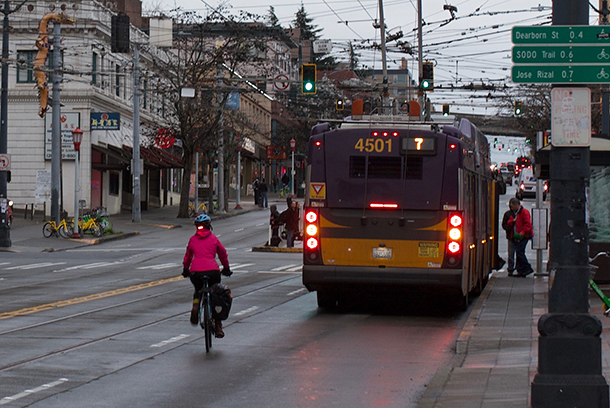
Program on the Environment student Ziyi Liu interned with Seattle Neighborhoods Greenways for his Capstone project, to learn why so few people bike in Seattle’s Chinatown International District, and what factors prevent people from traveling on two wheels.

Ziyi’s research question asked: “How does bike infrastructure affect cycling safety in the Chinatown-International District?”

His findings revealed that safety was a huge concern, and that in the International District there are very few protected bike lanes, compared to other busy neighborhoods in Seattle. With added infrastructure and smarter design, biking could become more accessible to residents.

“A protected bike lane is not only for cyclists, but it’s for everybody—it’s about the community and community happiness.” – Ziyi Liu

Ziyi’s findings indicate that building a connected network of protected bike lanes encourages more people to bike, and gives better transportation choices to individuals of all ages and abilities especially in parts of the city with lower car ownership. Ziyi also looked at the demographics of who bikes in Seattle and found some upward trends.

Read more about Ziyi’s research findings in the post below by International Examiner and see his Twitter presentation explaining his Environmental Studies Capstone experience.

http://www.iexaminer.org/2018/07/why-dont-more-people-bike-in-the-chinatown-id-lack-of-bike-infrastructure-makes-them-feel-unsafe/


Join us for the Spring 2018 Capstone Symposium

The Program on the Environment will host our Spring 2018 Capstone Symposium on May 23 at the Fisheries Sciences Building. We welcome all to attend and support students as they present on the culmination of three quarters of hard work.

The Capstone Course Series is a highlight for many students, and serves to catapult some into their first jobs or even their dream careers. Through internships, research, social media training, students come out of the experience well-equipped to communicate about the problem they sought to solve, and to tie their academic learning with specific research questions.

See below for the schedule and some sneak peeks from each session!

This event is open to the public and we encourage students interested in learning about the Capstone, as well as members of our community, to join us. There will be beverages and snacks. For those who can’t attend in person, follow our live tweets on Twitter: #POEcap.

Spring 2018 Symposium Schedule

Wednesday May 23

4:30PM Welcoming remarks/housekeeping

Session A – Poster I: Agriculture & Food systems, Green business & Sustainability, Natural Science & Conservation

4:35 – 5:15PM
Summer Cook – Full circle in the remote tropics: 5 ways to optimize permaculture in unconventional settings
Lexie Gray – Greening sports: How athletic facilities can implement change to save money and the environment
Nazmah Hasaan – Improving accessibility of the UW Sustainability Climate Action Plan website
David Hedin – Visions of restoration at Daybreak Star Cultural Center
Elena Hinz – Contaminants, comparisons, and consequences: The three c’s of a water quality assessment
Shunxi Liu – Community engagement programs can align with the co-creation mission in higher education sustainability
Carla Marigmen – Improving the efficiency of operations and behaviors within athletics facilities
Staci McMahon – Predicting the effects of climate change on flatfish distributional shifts into the Chukchi Sea
Jennifer Mitchell – Achieving campus sustainability: What practices universities are doing to become leaders in campus sustainability
Colin Piwtorak – From top to bottom and back again: How citizen science at all levels can be used to its greatest potential
Clyzzel Samson – How low income food bank clients’ concern for the environment and food waste is underestimated
Lex Savanh – Developing an alternative to cable ties for bird tagging
Uyen Tran – Sustainable finance and investment in higher education institutions: Reasoning and best practices
Brandon Wech – Trees aren’t just for the Lorax anymore: Measuring Northwest permaculture efficiency
Yunbo Xie – Promoting sustainable moves in a citizen science project and correlating volunteers’ motivations with their ongoing status
Hualian Xu – Endangered species “summer chum”: A way to save them

Sneak peek: Uyen Tran interned with UW Sustainability to examine sustainable finance and investment in higher education institutions. She conducted a competitive analysis along with two other students of the STARS (Sustainability Tracking, Assessment & Rating System) ranked colleges and looked into which higher ed institutions use SRI stocks and why that’s significant.


Session B – Capstone lightning talks

5:20PM Introduction 
Danielle Elizabeth Bogardus – E.W.W!! Education, Waste, and Water: A case study in the Las Piedras Region of Peru
Frieda Elise Luoma-Cohan – From the lab to the classroom: The use of non-traditional teaching tools in science communication
Samantha Anne Orcutt – The dirty side of business: How communication is key to streamline waste management practices
Yushan Tong – Value and use of Discovery Park by Chinese communities in Seattle
Tyler Sing Ung – Raising environmental awareness in a digitized world: The effectiveness of visual art and photography
Ha Young Yoo – Returning to the roots of sustainable ecotourism: Indigenous Knowledge is power rooted in ecology

Sneak peek: Danielle Bogardus has spent 4 years conducting work in a remote area of Peru, with an alumna’s non-profit, Hoja Nueva, on assessing and developing a waste management toolkit for remote native and migrant communities in Peru’s Las Piedras region that don’t have systems in place to dispose of waste. Danielle will seek to replicate and scale this toolkit in other communities after she graduates. 


Session C – Poster II: Education & Outreach, Policy & Regulation

6:15 – 7:00PM
Sean Adair – Assessing the impact of environmental education on childhood awareness and relationship to nature
Maggie Brown – Benefits to food recovery: Improved resource conservation through effective outreach methods
Sungkun Choi – Back to the science
Sara Clark – A necessary evil? Various perspectives towards salmon hatcheries
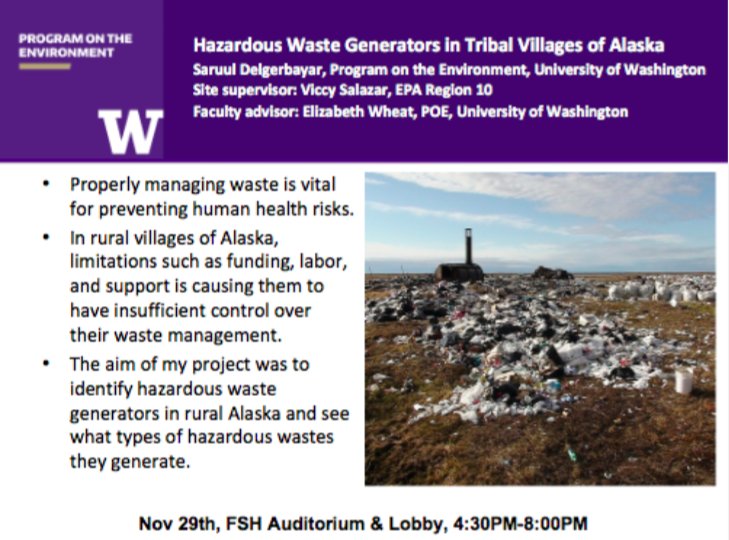
Saruul Delgerbayar – Hazardous waste generators in tribal communities of Alaska
Marlee Grasser – Puget Sound high-risk facilities in relation to environmental justice
Bridget House – Bluff erosion mitigation: Should it be incorporated into restoration strategies?
Katie Hunger – Sorting trash, there’s gotta be a better way!
Soondus Junejo – The need for mandatory environmental screening in daycare settings in order to minimize the health risk for children
Ziyi Liu – How does bike infrastructure affect cycling safety in the Chinatown-International District
Shelby Logsdon – Park or ride? An analysis of Washington State park transit accessibility
Chance O’Neal – The age of information: Improving the reliability of environmental websites
Rachel Pemberton
 – Underserved and overlooked: The roles of race and income in environmental advocacy
Gloria Piekarczyk – We’re all part of the problem, but who wants to be part of the solution?
Ellen Short – What’s gender got to do with it? How ecofeminism could save the planet
Chelsy Sirnio – Early outdoor education: Reconnecting children with nature

Sneak peek: Saruul Delgerbayar worked with the EPA on hazardous waste generators in rural villages of Alaska. Saruul assisted with EPA’s pilot program to backhaul hazardous waste from tribal communities lacking waste management systems and conducted interviews to identify the types of hazardous waste generated, to inform regulations that would benefit the communities’ overall health.


A snapshot of Saruul's Capstone research findings.
A snapshot of Saruul’s Capstone research findings.

Volunteer for the Special Olympics USA Games in Seattle

This summer, July 1-6, Seattle and the University of Washington will host the Special Olympics USA Games. Anticipated to attract more than 70,000 spectators, athletes and coaches from across the United States, Seattle is presented the challenge of planning this large-scale event with sustainability at the forefront of its operations; this includes tackling areas like waste management, food production, transportation, and education and outreach. Going above and beyond green operations, the Special Olympics plans to create a legacy of sustainability so that visitors of Seattle, regardless of their prior practices, may take home with them and share their positive experiences in sustainability, fostering sustainability in their communities as well.

The Special Olympics USA Games needs your help to realize these important sustainability goals! 

The UW Seattle campus will host more than 4,000 athletes and coaches as well as host eight of the fourteen Special Olympics USA Games events. Special Olympics USA Games needs volunteers to make sure that the USA Games are a success and that the athletes, their families and spectators have a great time.

Program on the Environment’s Winter Sustainability Studio worked directly with the Special Olympics volunteer team to envision sustainability initiatives to implement during the games, and one recommendation, Cupanion, a program aimed at reducing single-use liquid containers, may be in use. Learn more about the games sustainability goals.

How you can get involved

There are a variety of volunteer opportunities including joining the games’ Green Team. Green Team volunteers will help support games and activities highlighting sustainability initiatives, and help people properly recycle and compost at key waste stations.

To volunteer, go to the Special Olympics USA Games UW Volunteers site and click “register.” On the next screen you’ll need to choose the “Access Coded Companies and Groups” option and then enter the code DAWGS2018.

Look for “University of Washington Green Team” to help with sustainability efforts, or choose any of the many other volunteer opportunities available. You’ll need to sign up for the volunteer shifts you’d like to help with, as well as a training & orientation session.

SIGN UP TO VOLUNTEER


Congratulations to Frieda Cohan, 2018 Bonderman Travel Fellow!

The Bonderman Travel Fellowship award affords students the extraordinary opportunity to travel across the world independently for a minimum of 8 months, to at least 6 countries (spanning 2 regions) in the world, with the aim to enrich students experiences and open their eyes to different cultures, customs, perspectives and lifestyles.

Frieda Cohan, 2018 Bonderman Fellow and Husky Green Awardee.

This year, we are proud to congratulate Frieda-Luoma Cohan, one of fifteen UW students to receive the fellowship. Frieda recently won a Husky Green Award for her leadership in stewarding an outdoor learning space on campus and coordinating recycling efforts at UW football games, and also returned from a Spring at Sea oceanography expedition.

Frieda grew up in Mt. Vernon, WA and has been deeply influenced by her experiences in outdoor schools and field classes, as well as other instances of non-traditional experiential learning and she is thrilled to be given the opportunity to explore the world in an immersive education setting. As she travels, she hopes to explore the very different ways in which science education is presented in each community she visits, how this learning process inspires a connection with the natural world, and how communities foster a sense of place in education. She is excited to be stretched out of her comfort zone, and to absorb, learn, be humbled, and share. She plans to visit Morocco, Ethiopia, Malawi, Mozambique, Bhutan, Thailand, Laos, and Vietnam.

Congratulations to all the Bonderman Fellows!


Frieda Cohan and Beth Wheat honored at 2018 Husky Green Awards

Congratulations to this year’s Husky Green Award winners from Program on the Environment, Frieda Cohan and Beth Wheat!

2018 Husky Green Award winners Frieda Cohan and Elizabeth Wheat
2018 Husky Green Award winners Frieda Cohan and Elizabeth Wheat.

This year, our program is thrilled to spotlight these two enthusiastic leaders who are walking the walk on sustainability, through environmental stewardship of green space and gardens and heartfelt teaching.

The 2018 Husky Green Awards recipients were honored on April 20 on Red Square as part of UW Earth Day celebrations. The awards are in their ninth year of recognizing leaders on the UW campus who demonstrate their dedication to the environment.

Frieda is an Environmental Studies major and plays an active role in the community. She took part in an independent study garden build project last year to help design the program’s Sustainable Learning Space, a recently restored garden space dedicated for outdoor learning. She took on the role of garden steward, helping to maintain the space by clearing the trails and planting native species. Frieda recently returned from Spring at Sea, where she spent three weeks aboard the R/V Revelle learning about oceanography and feeding her passion for marine conservation.

“A big part of sustainability to me is creating safe and welcoming spaces for discussion and dialogue, ensuring that all people feel empowered to take action.” – Frieda Cohan

As part of her leadership on campus, Frieda is co-president of SAGE (the Student Association for Green Environments), and co-organizes activities and events such as last year’s Art to Inspire, a group effort to gather the UW community to celebrate art as a vehicle for raising environmental awareness.

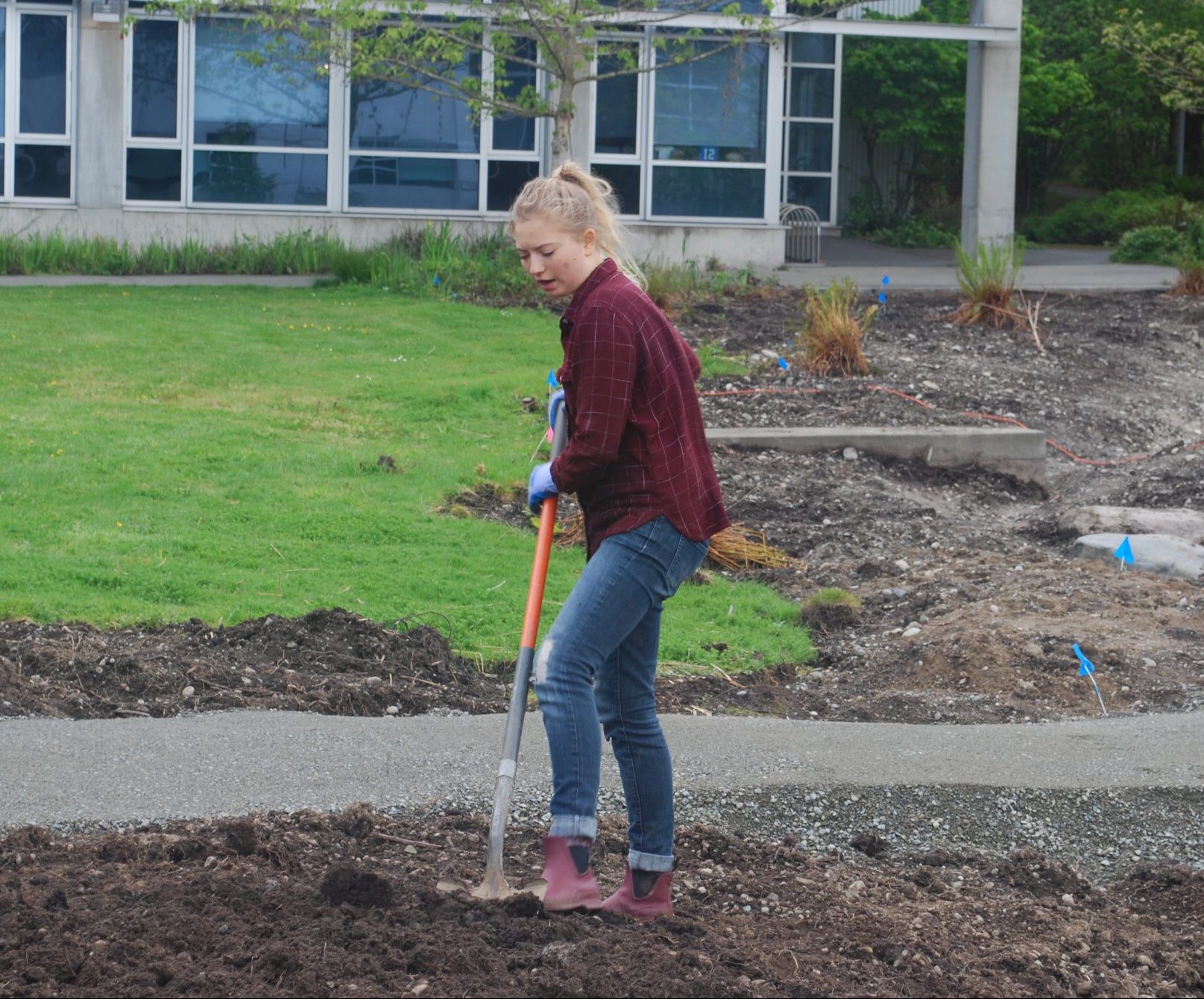
Frieda digging up some dirt during the construction of the Sustainable Learning Space.

She has coordinated recycling efforts at UW football games as part of her involvement with SAGE and last year UW Athletics recorded their highest waste diversion rates ever.

After she graduates, Frieda will help onboard the next Sustainable Learning Space garden steward and then embark on a grand adventure to travel through SE Asia and parts of Africa, an experience made possible by her recent award as a Bonderman travel fellow.

In her own words: “Over the last few years the environmental community at UW has become my home, and the unwavering compassion and strength of my peers, faculty, and staff never ceases to inspire and guide me. A big part of sustainability to me is creating safe and welcoming spaces for discussion and dialogue, ensuring that all people feel empowered to take action. And though the natural world is a shared experience, its beauty and significance remains unique to each beholder, and each reasoning for protecting it is critical.”


Beth at SkyRoots, her farm on Whidbey Island.

Beth is a lecturer at Program on the Environment and teaches a variety of courses, including The Urban Farm, Attaining a Sustainable Society, Introduction to Environmental Studies and Agro-ecology of Cascadia. Awarded the UW’s Excellence in Teaching Award in 2010, Beth exudes passion and inspires students to mindfully navigate the world when making decisions that impact others.

In her own words: “Sustainability means confronting our privilege and asking ourselves how we arrived in the place where we are in regards to our relationship with the planet and with each other. We can’t solve the issues facing our planet today without consciously confronting the economic and societal institutions that brought us here. Working on sustainability in this context with our students is a source of great joy for me!”

Beth’s interest in agriculture grew after working on the UW Farm as a graduate student and today she sits on the board of the Farm and frequently takes her class onto the farm at UW, to increase students’ awareness around sustainable urban agriculture. She also takes students to her own farm, SkyRoots, on Whidbey Island, to demonstrate how small-scale integrated farms can provide sustenance, while giving back to the earth and to the farmers. A shared meal and laughter always follows.

“Sustainability means confronting our privilege and asking ourselves how we arrived in the place where we are in regards to our relationship with the planet and with each other.” -Beth Wheat

Read more about Beth’s teaching path and love for sustainable agriculture on the Whole U Faculty Friday spotlight.


Faculty Friday: Elizabeth Wheat

Elizabeth Wheat
Elizabeth Wheat

Today we celebrate Beth Wheat, committed Program on the Environment lecturer and founder of SkyRoot Farm on Whidbey Island, who will receive a Husky Green Award at the Earth Day festivities on Red Square.

In Whole U’s Faculty Friday spotlight, Beth shares her love for growing food, a love that was born when she was a graduate student at UW, and grew to become a full fledged passion.

She shares this passion with us all, through her partnership with the UW Farm; through the classes she teaches: The Urban Farm, Sustainable Societies and Agro-Ecology of Cascadia; and through SkyRoot, a 20-acre integrated animal and vegetable farm on Whidbey Island. The farm takes an ecosystem-based approach to land management and agriculture (which includes using goats to maintain the blackberries, ducks to control the slug population and poultry to build the soil and manage the weeds).

Beth often takes students to SkyRoot Farm as an active-learning experience to show them how urban agriculture practices can benefit the environment and human health. She believes that changing how small-scale farms operate can contribute to solving the climate change problem—capturing carbon in the form of organic matter and storing it in the reserves of soil. In her teaching practices, she impresses upon her students the importance of connecting to their heart space, and how the trade-offs they face in our modern society can be influenced by the difference they want to make in the world.

Read more at Whole U

“Working a small farm is one of the most powerful jobs a person can do in that it leads to health in a lot of ways—there’s a cascading impact.” – Elizabeth Wheat